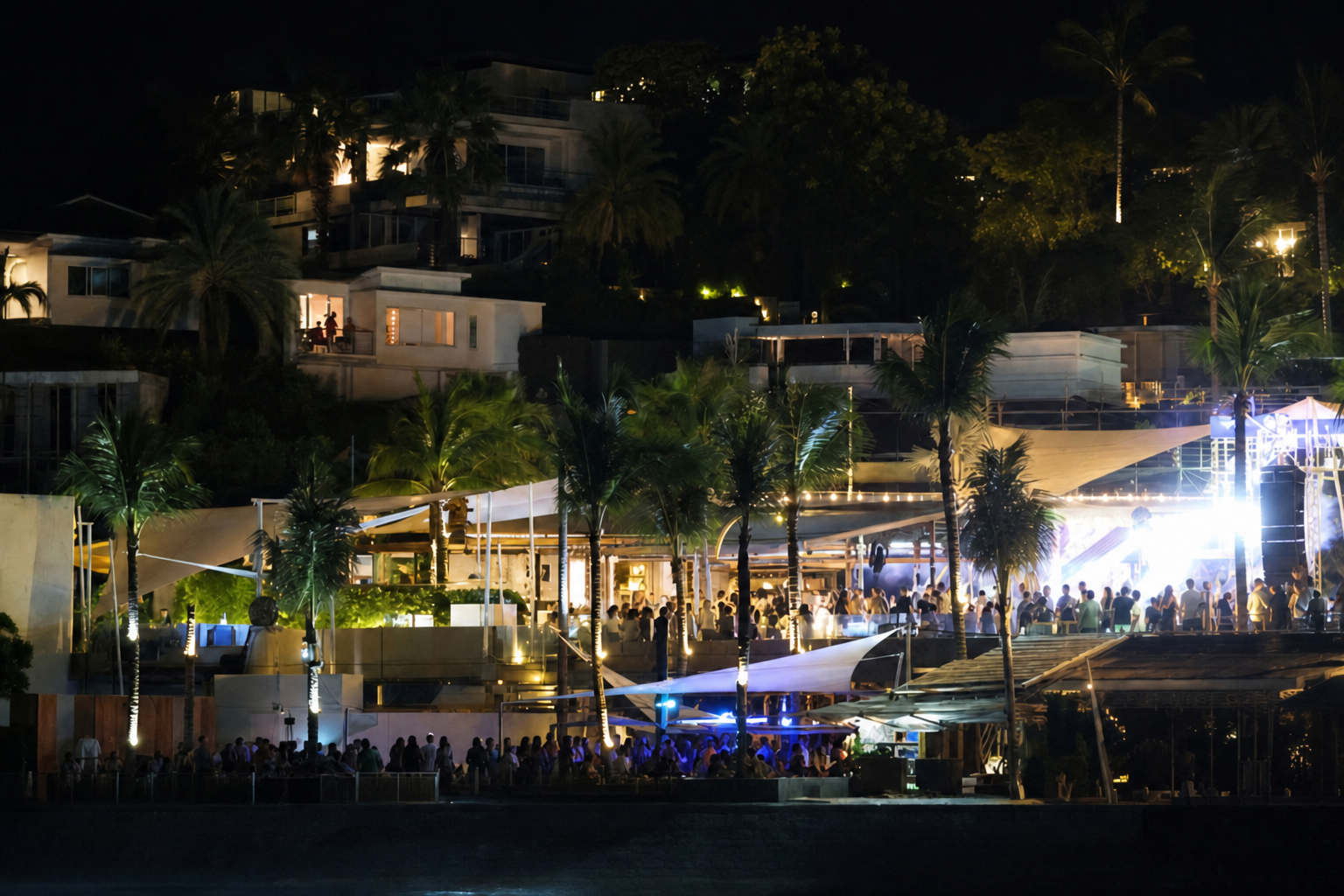
The recent enforcement of a landmark Supreme Court ruling in Thalang, which saw officials plaster eviction notices across disputed coastal plots in Bang Tao, was heralded as a major victory for the rule of law. For years, residents across Bang Tao and Cherngtalay have endured relentless nightly acoustic “torture” from oversized sound systems blasting heavy bass into strict residential zones until dawn. Prominent venues like Maya Beach Club, Yuuhi Beach Bar and Karaoke, and others have thrived on massive profits generated on public coastal sand.
Yet, as eviction notices go up across more than six rai of contested land-encompassing 16commercial establishments and 18 residential properties-we are asking a glaring question: How is it possible that these lawbreaking operations continue to slip through administrative loopholes, re-open under new proxy names, and resume their midnight noise disturbances?
The Revolving Door of Proxy Rebranding
The core frustration among long-term residents stems from a history of token enforcement. Historically, outlaw venues faced little more than seasonal fines, temporary closures, or staged compliance theater. When pressured by authorities or mounting noise complaints, foreign-backed operators frequently exploit nominee structures, using Thai proxy shareholders or nominal directors to register a “new” business entity at the exact same address.
While the Ministry of Commerce’s Department of Business Development (DBD) has introduced lifecycle scrutiny and mandatory financial proof to combat illegal foreign nominee networks, the transition speed of local bureaucracy often lags behind corporate shell games. If an establishment is ordered to vacate a plot due to land encroachment, what prevents the underlying investors from simply transferring their massive sound systems, liquor stocks, and management teams fifty meters down the coast under a fresh corporate banner?
The Accountability Gap
The recent intervention-sparked by high-level visits from national leadership and coordinated by ISOC, the Thalang District Office, and regional police-has mapped out disputed title deeds and commercial footprints. However, notice postings that omit strict compliance deadlines or fail to target the ultimate beneficial owners leave doors wide open for legal appeals and continuous delays.
For residents and tourists whose sleep is shattered nightly, the distinction between a “fact-finding committee” and definitive penal action feels dangerously wide. If high-profit beach clubs can operate for years on public land, amass millions in revenue, and walk away unscathed or seamlessly re-emerge under a relative’s name, the deterrent effect of a Supreme Court ruling evaporates.
What Authorities Must Do Next
To ensure these venues cannot simply wipe the slate clean under new proxy names, local and national authorities must immediately enforce the following steps:
- Asset and Equipment Seizure: Eviction notices must be paired with immediate physical seizures of commercial assets, including the high-powered sound systems and commercial staging used to violate residential noise ordinances.
- Direct Personal Liability for Nominees: Extend criminal investigations beyond corporate shells to actively prosecute Thai proxy holders and front-persons who lend their names to illegal foreign operations, applying heavy deterrent fines and prison sentences under the Foreign Business Act.
- Blacklisting Beneficial Owners: Cross-reference passport numbers and actual financial beneficiaries-not just paper directors-ensuring that foreign investors caught illegally occupying public land are permanently blacklisted from holding Thai business visas.
- Rigorous Decibel and Zoning Audits: Tie any future commercial licensing in Cherngtalay to strict acoustic compliance, automatically revoking permits for venues that turn residential zones into open-air nightclubs.
The community and Sangop is watching closely to see if this judicial action marks the permanent end of midnight impunity in Phuket, or merely another temporary pause before the bass starts thumping again.